
The Real Cost: Arusha Airport (ARK) vs. Kilimanjaro International (JRO)
When travelers ask, “Is it cheaper to fly from Arusha or Kilimanjaro to Zanzibar?”, they are often looking at the ticket price alone. However, the true cost of your flight involves a calculation of airport transfer fees, luggage restrictions, and your specific itinerary location. In Tanzania, the price difference for the flight itself is often negligible, but the logistical costs—what you pay to get to the airport—can vary significantly.
As a local operator, we often see travelers book a flight from the wrong airport simply because they didn’t realize how far apart they are. Arusha Airport (ARK) is a small, regional hub located right in the city, while Kilimanjaro International Airport (JRO) is an international gateway located roughly 50 kilometers (about an hour’s drive) away from Arusha town. Choosing the wrong one can turn a short, budget-friendly flight into an expensive logistical headache.
Pro Tip: If you are ending your Kilimanjaro climb, you are likely already near the Moshi/Kilimanjaro area. If you are finishing a safari, you are likely back in Arusha. Your location at the end of your trip is the primary driver of which airport is actually cheaper for you.
Understanding the Logistics of Your Departure
To determine which option is truly cheaper, you must evaluate where you will be spending your final night before flying to the coast. The “cheaper” flight is the one that minimizes your ground transfer costs and travel time.
Flying from Arusha Airport (ARK)
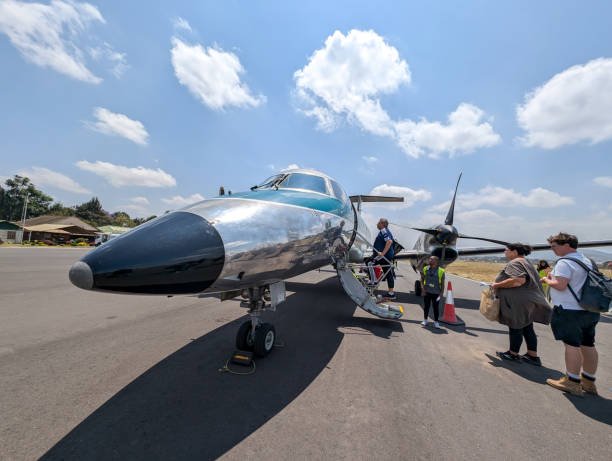
Arusha Airport is highly convenient if you are staying in Arusha city. It primarily serves domestic bush flights. The airlines operating here (such as Coastal Aviation, Auric Air, and Precision Air) often use smaller aircraft.
- Best for: Travelers ending a safari who are staying at a hotel in Arusha.
- Cost Factor: You save on the taxi or shuttle fare to JRO, which can range from $50 to $80 USD depending on your vehicle choice.
- Luggage Caution: These flights are often on smaller planes with stricter weight limits (typically 15kg in soft bags). If you have heavy climbing gear, this can lead to excess baggage fees that negate any savings on the ticket.
Flying from Kilimanjaro International Airport (JRO)
JRO is the main international hub. It handles larger jets and has more frequent departures to Zanzibar throughout the day.
- Best for: Travelers who have just finished a trek on the mountain, or those who prefer larger aircraft and more flexible flight times.
- Cost Factor: You must factor in the transfer time and cost from your hotel. If you are staying in Arusha, you need to account for the drive to the airport. If you are staying in Moshi, JRO is significantly closer and cheaper to reach than driving all the way back to Arusha for a flight from ARK.
- Luggage Flexibility: Because JRO handles larger planes, they are generally more accommodating with standard luggage weights compared to the strict “bush plane” requirements at ARK.
| Factor | Arusha Airport (ARK) | Kilimanjaro Int’l (JRO) |
|---|---|---|
| Location | Within Arusha City limits | ~50km from Arusha, ~40km from Moshi |
| Aircraft Type | Small, regional prop planes | Larger commercial jets & regional planes |
| Transfer Cost | Low (short taxi ride) | Higher (longer drive from Arusha) |
| Luggage Rules | Strict (usually 15kg, soft bags) | Standard airline limits |
| Best For | Safari guests in Arusha town | Climbers finishing in Moshi/Arusha |
The Hidden “Total Trip Cost” Calculation
When you are comparing the price, do not look at the flight ticket in isolation. You should consider the total cost of the departure day. For instance, if a flight from Arusha (ARK) is $150 and a flight from Kilimanjaro (JRO) is $130, the JRO flight appears cheaper. However, if your hotel is in Arusha, you have to pay for a private transfer to JRO. That transfer might cost you $60, making the total trip cost $190, whereas the ARK flight would have cost you $150 plus a $10 taxi ride ($160 total).
We see many travelers make this mistake. They see a slightly cheaper flight price on a booking engine but fail to calculate the cost of the road transfer required to reach the more distant airport. Always verify your hotel location relative to the airport before confirming your ticket.
For more specific details on how these airlines operate, you can review our guide on Kilimanjaro Airport to Zanzibar Flights, which breaks down the carriers and typical schedules.
Safari vs. Trek: Which Airport Fits Your Itinerary?
Your choice should be dictated by your post-trip logistics. Our team at Climb 4 Africa frequently manages these transitions, and we generally advise the following:
If You Are Coming From a Safari
Most safari packages end in Arusha. If your safari finishes in the afternoon, you might be looking for a late-day flight to Zanzibar. Arusha Airport (ARK) is often the most efficient choice here. You can finish your game drive, get dropped at your hotel or the airport, and be in Zanzibar by the evening. Read more about this in our comparison of Serengeti to Zanzibar vs Arusha to Zanzibar to see which flow suits your wildlife itinerary.
If You Are Coming From a Kilimanjaro Climb
Climbers often stay in Moshi for their final night to celebrate. If you are in Moshi, JRO is the only logical choice. It is the closest airport to the mountain base. Trying to reach Arusha Airport from Moshi to catch a flight is unnecessary and adds stress to your final day. We prioritize JRO departures for all our trekking clients to ensure they get maximum rest after the summit.
Booking Guidance: How to Secure the Right Flight
When you are ready to book, don’t just rely on aggregate flight search engines that might suggest an airport based on price alone without knowing your ground logistics. We recommend the following steps:
- Confirm your final night’s location: Will you be sleeping in Arusha or Moshi?
- Check your gear volume: Are you carrying your trekking duffel bags to the beach? If yes, check the airline’s specific luggage policy for the flight you are looking at.
- Coordinate with your operator: If you have booked a package with us, ask us to coordinate the flight booking alongside your transfer. We can ensure the flight time allows for a safe and relaxed transfer from your hotel.
If you are still in the planning phase and trying to decide which route works best for your 2026 or 2027 trip, reach out to our team. We can help you weigh the flight options against your total itinerary cost. You can reach us via WhatsApp at +255 747 477 898, email us at climb4africa@gmail.com, or use our backup contact at info@climb-4-africa.com. Let us know your planned end date and hotel location, and we will provide the most efficient travel plan for your Tanzanian adventure.
Frequently Asked Questions About Tanzania Domestic Flights
Can I change my flight if my trek finishes late?
Most regional tickets in Tanzania have strict change policies. If you are booking flights yourself, ensure you book a departure time that provides a significant buffer after your expected arrival from the mountain or safari. We generally recommend flights that depart in the afternoon to account for any unexpected delays on the road.
Do flights from Arusha (ARK) always use small planes?
Yes, the vast majority of aircraft operating out of Arusha Airport are light aircraft (like Cessna Caravans). These are fantastic for the experience, but they do have stricter baggage limits than the commercial jets at JRO. If you have a large suitcase, JRO is usually the safer bet.
Is it cheaper to book a return flight or one-way?
In the context of Tanzanian domestic travel, return tickets rarely offer the same “discount” structure you see with international carriers. Often, booking two one-way tickets on different airlines is just as cost-effective and gives you more flexibility to choose the best departure times for your specific trip flow.
Does weather affect flight availability?
Yes, especially during the rainy seasons (typically April/May and November). Smaller planes at Arusha Airport are sometimes more sensitive to weather conditions than the larger aircraft at JRO. If you are traveling during these months, JRO can sometimes offer slightly more reliability for your onward connection to Zanzibar.
Navigating Luggage Constraints and Weight Limits
One of the most overlooked factors when calculating whether it is cheaper to fly from Arusha (ARK) or Kilimanjaro (JRO) is the hidden cost of excess baggage. Because the aircraft types differ significantly between these two airports, your luggage strategy—and the potential fees attached to it—can drastically alter your total trip expenditure.
At Arusha Airport (ARK), the majority of flights are operated by smaller, regional bush planes like the Cessna Caravan. These aircraft have strict weight capacities. While the standard allowance is often 15 kilograms (33 lbs) in soft-sided bags, exceeding this limit usually results in a per-kilogram surcharge that can be quite steep. If you are traveling with a heavy camera kit, specialized trekking gear, or multiple suitcases, you might find yourself paying significant “excess baggage” fees at check-in. In some cases, if the flight is full, the airline may even require you to purchase an extra seat just to accommodate your luggage, effectively doubling the cost of your ticket.
Conversely, Kilimanjaro International Airport (JRO) handles larger, commercial jet aircraft. These planes operate with more robust cargo holds and higher weight allowances. If you are carrying a larger volume of gear, the commercial airlines at JRO are generally more forgiving. They are better equipped to handle standard hard-shell suitcases, which are often prohibited or discouraged on the smaller bush planes at ARK. If you are debating between the two, do a quick inventory of your bags. If you are carrying more than the standard 15-20kg allowance, the “cheaper” flight from Arusha could quickly become more expensive than the JRO flight once you factor in these weight penalties.
The Time-Value Trade-Off: Airport Transfers and Waiting Periods
When analyzing costs, travelers often forget to place a monetary value on their time and the convenience of their ground transfers. The cost of a taxi or private transfer from a hotel in Arusha to JRO is significantly higher than a transfer from the same hotel to Arusha Airport (ARK). This is a simple matter of distance; JRO is located roughly 50 kilometers away, requiring a 60-to-90-minute drive, whereas ARK is often just a 15-to-20-minute drive from the city center.
However, the “cheaper” option depends on your specific hotel location. If you are staying at a lodge on the outskirts of Arusha, closer to the airport road, the price difference for the transfer might be negligible. But for those staying in the city center, the transfer to JRO can add $50–$80 USD to your total trip cost, depending on your mode of transport. When you add this to the ticket price, the JRO flight might actually be the more expensive choice, despite a potentially lower base fare. Always verify the transfer cost with your hotel concierge or local driver before finalizing your flight booking; a seemingly bargain flight from JRO can easily be negated by the cost of the long-distance taxi ride required to reach it.

Navigating Flight Disruptions and Cancellation Protocols
One of the most significant, yet rarely discussed, differences between Arusha Airport (ARK) and Kilimanjaro International Airport (JRO) is the operational response to flight disruptions. When you book a flight from Arusha Airport, you are primarily dealing with bush airlines. These carriers operate on a dynamic schedule; while they are highly efficient, their operations are more susceptible to minor disruptions due to technical checks, pilot hours, or last-minute airstrip closures in the Serengeti or other parks. If your flight is delayed or cancelled, the recovery process is often manual and personalized. You are typically in direct contact with the airline or your booking agent, and re-accommodation depends on seat availability on the next available light aircraft, which might not be until the following morning.
Conversely, JRO functions as a standard international hub. If a flight is disrupted here, you are often dealing with larger commercial carriers that have more robust customer service protocols, digital rebooking systems, and interline agreements. If a major carrier cancels a flight, they are generally better equipped to reroute you or provide vouchers for accommodation and meals. When calculating the “cost” of your flight, consider the value of this safety net. If your itinerary is extremely tight—for example, if you are flying to Zanzibar to catch a connection to an international flight—the inherent stability of the JRO network provides a logistical buffer that the bush-flight model at Arusha simply cannot match.
Airport Amenities and Pre-Flight Comfort: A Comparison
Travelers often underestimate the “waiting cost” associated with airport facilities. Arusha Airport (ARK) is essentially a small, functional terminal designed for rapid transit. It offers limited seating, basic restroom facilities, and a very small cafe area. If you arrive early or face a delay, there is very little in the way of comfort. You are essentially waiting in a communal space with few amenities to pass the time. For many, this is part of the “authentic” Tanzania experience, but it can be taxing after a grueling week of trekking or safari.
Kilimanjaro International Airport (JRO), by comparison, offers a significantly different environment. As an international gateway, it features dedicated departure lounges, duty-free shops, multiple dining options, and more comfortable seating areas. If you have a long layover or an early arrival, you can comfortably work, eat, or rest. When deciding between the two, ask yourself how much you value comfort on your final day. If you are exhausted and just want to get to the beach, the “cost” of the extra hour of transit to JRO might be offset by the ability to relax in a lounge or grab a proper meal before your flight to Zanzibar. This is a qualitative factor that rarely appears on a price comparison website but is frequently cited by travelers as a major contributor to their overall trip satisfaction.
The Financial Impact of Booking Strategies: Through-Tickets vs. Independent Carriers
When calculating whether it is cheaper to fly from Arusha or Kilimanjaro to Zanzibar, travelers often overlook the mechanism of their ticket purchase. The price you see on an aggregator site can be deceptive because it may not account for the “risk premium” of your booking strategy. In the Tanzanian aviation market, there is a fundamental split between booking a single through-ticket (connecting your international flight to your domestic leg) and booking separate, independent domestic tickets.
If you book your flight from Arusha or Kilimanjaro to Zanzibar as part of a single reservation with your international airline (often via codeshare agreements with local carriers), you are purchasing a through-ticket. This is generally more expensive upfront. However, the financial benefit lies in the protection it provides. If your international flight arrives at Kilimanjaro International Airport (JRO) delayed, and you miss your domestic connection to Zanzibar, the airline is obligated to rebook you at no extra cost. When you book separate tickets—for example, flying into JRO on an international carrier and then purchasing a completely separate ticket on a local budget airline—you are responsible for the full cost of a new ticket if your international flight is delayed. In this scenario, the “cheaper” flight often ends up being the most expensive option if a disruption occurs.
Conversely, if your itinerary is flexible and you have a buffer day between your international arrival and your domestic departure, booking independent tickets is almost always the most cost-effective route. This allows you to cherry-pick the cheapest operator, such as Precision Air or regional carriers, regardless of which international airline brought you to Tanzania. The key takeaway for the cost-conscious traveler is that the “cheaper” flight is not just the one with the lower fare; it is the one that aligns with your risk tolerance regarding potential delays.
Analyzing Ground Transfer Costs: Private Taxi vs. Hotel Shuttles
A significant portion of your total transit budget is consumed long before you reach the check-in counter. When determining the “cheaper” airport, you must audit the cost of your ground transport, which varies wildly based on your starting point. Arusha Airport (ARK) is located roughly 8 to 10 kilometers from the city center, while Kilimanjaro International Airport (JRO) is situated approximately 50 kilometers away. This distance difference is a primary driver of the final “total trip cost.”
For travelers staying in Arusha city, a private taxi to Arusha Airport is typically a short, predictable trip. Because the distance is minimal, the fuel and time costs for the driver are lower, resulting in a significantly lower fare. In contrast, the transfer to JRO requires a longer drive, often taking an hour or more depending on traffic conditions on the Arusha-Moshi highway. This transfer cost is rarely included in the flight price, and if you are paying for a private vehicle, it can add a substantial amount to your daily budget. If you are a solo traveler or a couple, sharing a shuttle or using a pre-booked transfer can mitigate these costs, but the base price for a JRO transfer will consistently exceed that of an ARK transfer.
Furthermore, consider the “hidden” time cost. If you are staying in Arusha and choose to fly from JRO, you must factor in the necessity of departing your hotel at least two to three hours before your flight to account for the transit and potential traffic. If you choose to fly from ARK, you can often leave your hotel just an hour or less before your flight. For many travelers, the “cheaper” option is the one that allows them an extra morning of rest or a final breakfast in town, rather than sitting in a taxi for an hour. While this is a qualitative factor, it is a critical component of the total value proposition of your travel day.
The Strategic Choice: When to Prioritize Location Over Price
There are specific scenarios where the price difference between the two airports becomes irrelevant because the logistical efficiency outweighs the savings. If you are finishing a climb on Kilimanjaro and your descent ends on the side of the mountain closer to Moshi, it is almost always more efficient to fly from JRO. The cost of transferring from the base of the mountain to Arusha Airport (ARK) to catch a flight is not only more expensive than a transfer to JRO, but it also forces you to traverse the busy Arusha-Moshi road twice. In these instances, attempting to save $20 or $30 on a flight ticket by choosing Arusha Airport is a false economy. The extra fuel, time, and physical fatigue of the additional transit often negate any savings you might have secured on the airfare. Always prioritize the airport that is geographically closest to your final night’s accommodation to ensure your transition to the coast is as smooth as possible.
Related Guides and Packages
Check Availability for Is It Cheaper To Fly From Arusha Or Kilimanjaro To Zanzibar? A Planning…
Ready to compare dates, prices, and the best option for your group? Send the package name and travel month so the team can reply with a clear quote, availability, and what is included.
Best Flights For Kilimanjaro Climbing And Zanzibar Holidays: A Planning Guide
A professional guide to optimizing your international and domestic flight strategy for a combined Kilimanjaro trek and Zanzibar beach holiday in 2026-2027.
View package detailsKilimanjaro Climbing And Zanzibar Package With Flights: Pricing Guide
A detailed guide on how to structure a Kilimanjaro climb and Zanzibar beach holiday, covering cost drivers, flight logistics, and route selection for 2026-2027.
View package details
Kilimanjaro Honeymoon Climbing And Zanzibar Beach Holiday: December Planning
A practical guide for couples planning a Kilimanjaro climb and Zanzibar beach holiday in December 2026, focusing on route selection, recovery logistics, and planning timelines.
View package detailsAfcon Kilimanjaro Safari And Zanzibar Package: Expert Planning Guide
A comprehensive guide to coordinating your AFCON 2027 travel, including Kilimanjaro trekking, Northern Circuit safaris, and Zanzibar relaxation, with expert logistical advice.
View package detailsKilimanjaro Vs Arusha Airport: Which Should You Use For Your Trip?
A practical guide to choosing between Kilimanjaro International Airport (JRO) and Arusha Airport (ARK) for your Tanzania safari or Kilimanjaro climb.
View package detailsKilimanjaro Airport To Arusha Transfer Cost & Booking Guide
A practical guide to navigating the transfer from Kilimanjaro International Airport (JRO) to Arusha, including cost factors, booking advice, and logistics for your 2027 trip.
View package details
Zanzibar To Nairobi Flight Price & Schedule: Planning Your Connection
A practical guide to navigating flights from Zanzibar to Nairobi, covering airport logistics, price factors, and how to coordinate your beach-to-safari transition.
View package detailsNairobi To Zanzibar Flights: Ticket Prices & Booking Guide
A comprehensive guide to understanding flight costs, airline choices, and logistics for the popular Nairobi to Zanzibar route.
View package detailsNairobi To Arusha Flight Price : A Practical Guide For Travelers
Planning your travel from Nairobi to Arusha or Kilimanjaro for 2027? Get expert advice on flight prices, route logistics, and how to book the right connection.
View package details
Zanzibar Flights During Christmas And New Year: Expert Booking & Pricing Guide
Essential guide for booking Zanzibar flights during the high-demand Christmas and New Year season, covering pricing realities, route strategy, and logistics.
View package details
Best Time To Book Flights To Zanzibar In : Planning Your Island Getaway
Expert advice on securing the best flight arrangements for your 2027 Zanzibar holiday, including seasonal booking windows and coordination with Tanzania safari itineraries.
View package detailsTanzania Flight Prices September : Serengeti And Zanzibar Planning
Expert advice on navigating domestic flight logistics, seasonal pricing, and the crucial 'bush-to-beach' connection for your September 2027 Tanzania itinerary.
View package detailsNo related package matches those filters. Clear one or more filters to see the other topic-matched options.



