
If you are planning an international trip to Tanzania for a Kilimanjaro climb or a northern circuit safari, the short answer is: you will almost certainly use Kilimanjaro International Airport (JRO). Arusha Airport (ARK) is a regional airstrip used primarily for domestic flights, bush planes, and hop-on connections within East Africa. Unless you are arriving on a small charter flight from Zanzibar or a neighboring national park, you should book your international flights directly into JRO.
Many travelers find themselves confused during the booking phase because both airports serve the same general region of northern Tanzania. However, their roles in your itinerary are completely different. Misunderstanding this distinction can lead to booking expensive, unnecessary connecting flights or finding yourself stranded at the wrong terminal when your transfer driver arrives.
Understanding the Role of Kilimanjaro International Airport (JRO)
Kilimanjaro International Airport (JRO) is the primary gateway for international tourism in northern Tanzania. It sits roughly halfway between the two major cities of the region: Arusha and Moshi. Because it is an international hub, it is equipped to handle large, long-haul aircraft from major carriers like KLM, Qatar Airways, Ethiopian Airlines, and Turkish Airlines.
For most climbers and safari-goers, JRO is the logistical anchor of the trip. If you are flying from the US, Europe, or Asia, you will land here. The airport is purpose-built to handle the influx of tourists arriving for the trekking season. When you book a Kilimanjaro climbing package, the logistics are almost always centered around a pickup at JRO. The transfer time from JRO to Moshi—the most common base for Kilimanjaro climbs—is typically about 45 to 60 minutes. If you are heading to Arusha for the start of a safari, the drive is also about an hour, depending on traffic.
Because JRO is designed for international traffic, the immigration and customs processes are streamlined for visitors. You will find visa-on-arrival desks, currency exchange services, and SIM card vendors right in the terminal, making it a much more traveler-friendly entry point for those unfamiliar with the country.
When (and Why) You Would Use Arusha Airport (ARK)
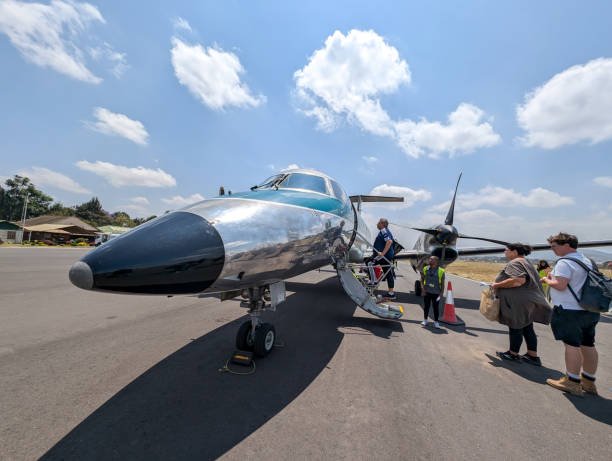
Arusha Airport (ARK) is a smaller, regional facility located much closer to the center of Arusha city. It does not handle large international jets. Instead, it serves as the hub for “bush flights”—the small, light aircraft that shuttle tourists between the Serengeti, Lake Manyara, and other remote airstrips. It also handles frequent flights to and from Zanzibar.
You would only use Arusha Airport if:
- You are doing a multi-leg trip: For example, if you finish a safari in the Serengeti and want to fly directly to Zanzibar, you might take a small plane from a bush strip to Arusha Airport, and then connect to a larger plane for the coast.
- You are combining a safari with a domestic business trip: If you are already in Tanzania and need to move between regions quickly using a domestic carrier like Precision Air or Regional Air.
- You specifically booked a bush-plane safari: Some luxury itineraries include transfers by air to avoid the long drives on bumpy roads. In these cases, your tour operator might route your domestic arrival or departure through ARK.
It is crucial to note that Arusha Airport has a very short runway and limited infrastructure. It is not an alternative to JRO for your arrival from overseas. If you search for flights from your home country to “Arusha Airport,” you will likely find very few, if any, results, or routes that involve multiple, complex, and expensive domestic transfers that are unnecessary.
Comparison: JRO vs. ARK
| Feature | Kilimanjaro International (JRO) | Arusha Airport (ARK) |
|---|---|---|
| Primary Function | International Arrivals/Departures | Regional & Domestic Hub |
| Suitable For | Climbers, Safari Travelers, Tourists | Domestic Connections, Bush Flights |
| Distance to Moshi | ~45-60 Minutes | ~2 Hours |
| Distance to Arusha | ~60 Minutes | ~15 Minutes |
| Flight Types | Large International Jets | Light Aircraft, Turboprops |
| Best For | Your arrival and departure | Internal Tanzanian travel |
The Logistics of Your Arrival
Regardless of which airport you choose, your transfer logistics are the most important part of your first and last day. When you arrive at Kilimanjaro International Airport, you will be met by your transfer driver. We always recommend that you have your transfer pre-arranged. If you are climbing with us, we coordinate your arrival time to ensure a smooth transition to your hotel.
If you are trying to decide which city to base yourself in, remember that your airport choice often informs that decision. If you are primarily climbing, Moshi is often the preferred base because it is closer to the mountain gates (like Marangu, Machame, and Umbwe). If you are primarily doing a safari, Arusha is the central hub. However, because JRO is centrally located, it serves both perfectly. You do not need to choose your airport based on the city; you should choose your airport based on flight availability and cost.
For those looking at flight costs and ticket prices, JRO is almost always the cheaper option because it is a major hub. Trying to route yourself through Arusha Airport usually involves booking two separate tickets (one to Dar es Salaam or Nairobi, and a second, separate ticket for the small plane to Arusha), which increases both the cost and the risk of baggage loss or scheduling delays.
Planning for 2026-2027
As you plan for your 2026 or 2027 trip, keep in mind that airline schedules to JRO can change seasonally. During the peak climbing seasons (typically January-February and June-October), airlines often add extra frequency to their JRO routes. We recommend booking your international flights as early as possible to secure the best rates.
When you are ready to finalize your itinerary, send us your flight details. We track your arrival, so even if there is a delay, our team will be there to meet you. If you are unsure whether your flight lands at JRO or if you are considering a complex multi-city route, feel free to reach out. We assist our clients with:
- Confirming if your chosen airport is the most efficient for your specific itinerary.
- Arranging private transfers from JRO to your hotel in Moshi or Arusha.
- Coordinating any necessary bush-plane connections if your safari itinerary requires it.
For any questions regarding your flight plans or to request a transfer quote, you can contact us via WhatsApp at +255 747 477 898 or email us at climb4africa@gmail.com. You can also reach our support team at info@climb-4-africa.com.
Common Misconceptions About Tanzanian Airports
One of the most frequent questions we receive is, “Can I fly into Nairobi and then take a bus to Kilimanjaro?” While this is physically possible, it is rarely recommended for climbers. The bus journey from Nairobi to Moshi/Arusha involves a border crossing at Namanga, which can be unpredictable and time-consuming. After a long-haul international flight, the last thing you want is a 6-8 hour bus ride with border bureaucracy.
Another common mistake is assuming that all flights landing in “Kilimanjaro” go to the same place. Some travelers confuse the mountain itself with the airport. The airport (JRO) is a specific facility. Always check your ticket code: JRO is the code you want. If your ticket shows ARK, you are heading to the domestic airstrip in Arusha, which might be a surprise if you expected to land at the international hub.
Finally, do not worry about the distance between the airport and your accommodation. Whether you stay in Arusha or Moshi, the transfer from JRO is standard. Most reputable operators, including Climb 4 Africa, include this transfer in their climbing packages, so you don’t need to worry about navigating local taxis or public transport upon arrival.
Summary for Travelers
To summarize your planning decisions:
- Book your international flight to JRO (Kilimanjaro International Airport). It is the most convenient, cost-effective, and standard option.
- Ignore Arusha Airport (ARK) for your arrival/departure. It is only relevant if you have specific domestic bush-plane legs within your itinerary.
- Coordinate your transfer early. Don’t leave your airport pickup to chance. Confirm your transfer with your tour operator at least 30 days before your departure.
- Focus on the destination, not the airport. The airport choice is a logistical detail; your focus should be on the quality of your guide, the route you are climbing, and the preparedness of your safari operator.
By keeping your arrival simple and flying into JRO, you start your Tanzanian adventure with the least amount of stress. This allows you to focus on the acclimatization, the packing, and the excitement of the journey ahead, rather than the logistics of airport transfers. If you are still in the early stages of planning your 2026 or 2027 trip, we are here to help you map out the best flight routes and ensure your ground transport is perfectly aligned with your arrival time.


Beyond the Runway: Baggage Constraints and Terminal Facilities
While the choice between Kilimanjaro International Airport (JRO) and Arusha Airport (ARK) is often framed as a simple logistical decision, there are specific, often overlooked operational realities—particularly regarding baggage and terminal facilities—that can dictate the success of your arrival. These nuances are critical for travelers who are combining a Kilimanjaro climb with a safari or a coastal excursion, as the transition between international and domestic flight segments requires more than just a change of ticket.
The “Soft Bag” Rule for Bush Connections
If your itinerary involves a transfer from an international flight at JRO to a domestic bush plane, you must be hyper-aware of the baggage limitations. International carriers arriving at JRO are accustomed to standard, hard-shell suitcases, which are perfectly acceptable for the drive from the airport to your hotel in Moshi or Arusha. However, domestic bush planes—the small, light aircraft that shuttle passengers from Arusha Airport or directly into national parks—are highly weight-sensitive and space-constrained.
These bush planes almost universally require soft-sided duffel bags without rigid frames or wheels. If you arrive at JRO with a large, hard-shell suitcase and expect to connect to a bush flight, you may face significant logistical hurdles. You might be forced to repack your gear into a soft bag at the last minute, or in worst-case scenarios, have your luggage held back for a later cargo flight. We strongly advise travelers to use a soft-sided duffel bag for their primary luggage if they have any domestic bush-flight legs in their trip. This simple preparation prevents the stress of repacking in an airport terminal and ensures your gear travels on the same aircraft as you.
Airport Infrastructure During Irregular Operations
Travelers often underestimate the massive difference in infrastructure between the two facilities, particularly if a flight delay or cancellation occurs. JRO is a fully equipped international hub with multiple dining options, lounges, duty-free shops, and significant seating areas designed to accommodate long wait times for international travelers. It is built to handle the ebb and flow of global traffic.
Conversely, Arusha Airport (ARK) is a compact, efficient regional facility. While it is perfectly functional for quick, scheduled departures, it is not designed for passenger comfort during extended delays. If you are rebooked or experience a significant delay while attempting to transit through ARK, you will find the amenities to be extremely limited. This structural difference reinforces why it is safer to treat JRO as your definitive anchor point. By minimizing the time spent navigating the smaller, more restrictive infrastructure of regional airstrips, you reduce the likelihood of encountering frustration during minor travel disruptions.
The “Meet and Greet” Environment at JRO
Upon exiting the arrivals hall at JRO, you will be met with a bustling, high-energy environment. It is standard for dozens of drivers and tour operators to be waiting behind the barrier, holding signs for their respective guests. This can be overwhelming after a long-haul flight. Because this area is crowded, it is essential to have a pre-arranged meeting point or a clear understanding of what your transfer vehicle looks like. Do not rely on finding a taxi on the spot if you have a pre-booked operator; your guide or driver will likely be waiting in the designated area. If you cannot spot your name, remain at the designated meeting point rather than wandering into the parking lot, as the sheer volume of vehicles can make it difficult for drivers to navigate and find their guests if they are not exactly where they were instructed to be.
The Departure Experience: Managing Your Final Day at JRO
While the focus is often on arrival, your departure from Kilimanjaro International Airport (JRO) requires a different set of logistical preparations, especially for returning climbers. Unlike international airports in major Western hubs, JRO is relatively compact, meaning that during peak departure hours—typically in the late evening when European-bound flights are scheduled—the terminal can become congested. We strongly recommend arriving at the airport at least three hours before your scheduled departure time. This buffer is not merely for check-in; it is to account for the unique “souvenir bottleneck.”
Many travelers purchase bulky wood carvings, Maasai blankets, or large paintings during their final days in Moshi or Arusha. These items often do not fit into standard carry-on luggage and must be checked. If you have not pre-arranged extra baggage allowance with your airline, you may find yourself scrambling at the check-in counter. Furthermore, JRO’s security protocols are thorough. You will pass through multiple checkpoints, and the final gate area has limited seating and dining options. If you are traveling as a group, it is helpful to consolidate your “souvenir” luggage into one or two checked bags before arriving at the terminal to streamline the process for everyone.
The “Inter-Airport” Transit: Navigating the JRO-to-ARK Connection
A frequent scenario for travelers combining a Kilimanjaro climb with a safari is the need to utilize both airports on the same day. You might land at JRO on an international flight and, after a brief hotel stay, require a domestic bush flight departing from Arusha Airport (ARK) to reach a remote safari airstrip. This transfer is not as simple as switching terminals in a major city. The drive between JRO and ARK takes anywhere from 60 to 90 minutes, depending on traffic conditions in Arusha town, which can be notoriously congested during morning and evening rush hours.
If your itinerary demands this connection, you must build in a significant “cushion” of time. Never schedule a bush flight from ARK that departs within three hours of your international flight’s arrival at JRO. Even if you land on time, immigration processing and baggage claim at JRO can take longer than expected during peak seasons. Furthermore, the transfer vehicle needs to navigate the busy streets of Arusha, where unexpected roadwork or weather conditions can easily delay your arrival at the smaller ARK facility. If you are booking these connections independently, always communicate your exact flight numbers to your ground operator; they are the experts in estimating the current traffic flow and can advise on the safest departure time for your bush flight.
Navigating Immigration: Visa on Arrival vs. E-Visa
The speed at which you exit the arrivals hall at JRO is heavily influenced by your visa preparation. While Tanzania offers a “Visa on Arrival” service at JRO, relying on this can significantly delay your exit. You may find yourself waiting in a lengthy queue to pay fees and have your fingerprints scanned, a process that can add an hour or more to your airport time after a long-haul flight. This is particularly stressful if your transfer driver is waiting in the parking lot and you have a long drive ahead to your hotel.
We strongly recommend applying for an E-Visa online well in advance of your trip. While the E-Visa system has its own quirks, having your documentation printed and ready typically allows you to bypass the primary payment queue and move directly to the verification line. This simple administrative step can drastically change your first impression of the country, allowing you to meet your guide and begin your transit to the mountain or safari lodge with minimal delay. When you arrive at JRO, look for the designated “E-Visa Holders” signs, which are distinct from the “Visa on Arrival” counters.
Navigating Baggage Irregularities and Gear Recovery at JRO
For the Kilimanjaro trekker, the arrival at Kilimanjaro International Airport (JRO) is not merely about clearing customs; it is the moment of truth for your equipment. While international carriers serving JRO generally maintain reliable baggage handling, the specialized nature of mountain gear—which is often packed in heavy, non-standard duffels—increases the risk of misrouting or delayed arrival. Unlike a standard vacation where missing clothes are a temporary inconvenience, missing technical gear at JRO can effectively halt your expedition before it begins.
If you arrive at the baggage carousel and your gear is missing, the most critical step occurs within the secure arrivals hall. You must locate the “Lost and Found” or “Baggage Services” desk immediately. Do not exit the terminal to find your driver until you have filed a Property Irregularity Report (PIR). This document is your legal claim to the luggage and is essential for tracking. The staff at JRO are accustomed to this process, but they operate under the constraints of the airline’s local ground-handling contract, which is often a third-party service rather than the airline’s own employees. This distinction is vital: the ground handlers may not have the authority to expedite your bag to the mountain base independently.
This is where the advantage of a professional, locally-based trekking operator becomes significant. Because these operators work daily with the cargo handling agents at JRO, they often have direct lines of communication to the ground staff that an individual traveler does not. If your bag is delayed, provide your PIR reference number to your operator immediately. They can often arrange for the bag to be tracked and, crucially, coordinate a “catch-up” delivery. In many cases, if a bag arrives on a flight the following day, the local operator can send a driver back to the airport to retrieve it and bring it to your hotel in Moshi or Arusha, or even meet you at a lower camp on the mountain. Attempting to manage this retrieval yourself while simultaneously preparing for a trek is logistically exhausting and often ineffective due to the language and bureaucratic barriers at the airport terminal.
Finally, avoid the temptation to rely on the airline’s promise to “deliver to your hotel.” While major carriers will eventually get the bag to your accommodation, their courier services in Tanzania may not have the flexibility to navigate the remote roads leading to mountain trailheads or specific lodges. Always ensure your mountain guide service is the primary point of contact for the airline’s baggage office once your initial report is filed. Their local knowledge of the airport’s cargo logistics is your best insurance against a lost bag ruining your climb.
Related Guides and Packages
Check Availability for Kilimanjaro Vs Arusha Airport: Which Should You Use For Your Trip?
Ready to compare dates, prices, and the best option for your group? Send the package name and travel month so the team can reply with a clear quote, availability, and what is included.
Kilimanjaro Airport To Arusha Transfer Cost & Booking Guide
A practical guide to navigating the transfer from Kilimanjaro International Airport (JRO) to Arusha, including cost factors, booking advice, and logistics for your 2027 trip.
View package detailsIs It Cheaper To Fly From Arusha Or Kilimanjaro To Zanzibar? A Planning Guide
Deciding between Arusha Airport and Kilimanjaro International for your Zanzibar flight involves more than just the ticket price. Discover how location, baggage rules, and transfer costs...
View package detailsNairobi To Arusha Flight Price : A Practical Guide For Travelers
Planning your travel from Nairobi to Arusha or Kilimanjaro for 2027? Get expert advice on flight prices, route logistics, and how to book the right connection.
View package detailsNairobi To Kilimanjaro Airport Flight Cost Guide
A detailed look at the factors influencing the cost of flights from Nairobi to Kilimanjaro Airport, including comparisons with land transfers and essential planning advice.
View package detailsKilimanjaro Climbing Package With Airport Transfers: Prices & Logistics
A detailed look at the logistics and pricing components of a full-service Kilimanjaro climbing package, focusing on the critical role of airport transfers and professional coordination.
View package details
Kilimanjaro Airport To Moshi Transfer Price : A Practical Guide
A practical guide to arranging your transfer from Kilimanjaro International Airport (JRO) to Moshi, covering price factors, vehicle options, and arrival logistics for 2027.
View package detailsKilimanjaro International Airport Flight Prices & Airlines: A Planning Guide
A deep look at planning your travel to JRO, understanding airline options, price variables, and how to coordinate your arrival for a successful Kilimanjaro climb.
View package details
Cheapest Airport To Fly Into For Climbing Kilimanjaro: A Guide
Is flying into Nairobi cheaper than Kilimanjaro for your trek? We break down the hidden costs of transfers, visas, and transit time to help you plan your 2027 trip.
View package detailsFlights To Mount Kilimanjaro: Ticket Prices & Airport Guide
A comprehensive guide to flying into Kilimanjaro International Airport (JRO) in 2027. Learn how to secure the best flights, what to expect at the airport, and how to align your arrival with...
View package details
How Early Should I Book A December Kilimanjaro Group Trek? A Planning Guide
Planning a December Kilimanjaro climb? Learn the ideal booking window, why holiday dates fill up fast, and how to secure your spot for 2026-2027.
View package details
Which Kilimanjaro Route Is Best For A New Year Summit? Expert Guide 2026
Selecting the right route for a New Year's summit on Kilimanjaro is less about speed and more about strategic acclimatization. Here is how to choose the best path for your 2026-2027...
View package details
Budget Kilimanjaro Trek With Airport Pickup And Hotel Accommodation: A Planner
A practical guide to securing a reliable, value-driven Kilimanjaro climb that includes essential airport transfers and comfortable hotel stays, ensuring your adventure starts smoothly.
View package detailsNo related package matches those filters. Clear one or more filters to see the other topic-matched options.



