
When planning a family safari or a trip to Zanzibar, one of the most common questions we receive at Climb 4 Africa involves the cost of travel for younger passengers. Many travelers naturally assume that child flight ticket prices in Tanzania follow the same logic as major international airlines, where significant discounts for children are the standard. However, the reality on the ground—especially when mixing domestic jet travel with small-aircraft bush flights—is significantly different.
Understanding these fare rules is critical for your 2027 travel budget. In Tanzania, airline pricing is segmented not just by age, but by the type of aircraft and the route you are flying. A failure to distinguish between these categories often leads to unexpected costs at the booking stage.
The Core Distinction: Infants, Children, and Adult Fares
Before you begin comparing quotes, you must categorize your family members according to the specific definitions used by Tanzanian aviation authorities. These definitions are strictly enforced for insurance and safety reasons.
- Infants (0–2 years): Generally, infants are considered passengers who have not yet reached their second birthday on the date of travel. On most commercial domestic carriers, they may fly for a nominal fee—often 10% of the adult fare—provided they sit on a guardian’s lap.
- Children (2–11 years): This is the bracket where policies diverge sharply. While some larger domestic carriers offer a percentage discount (often 25% off the base fare, though rarely on taxes), many operators do not offer this for every fare class.
- Adults (12+ years): Anyone aged 12 or older is almost universally charged at the full adult rate. There are no exceptions to this rule, regardless of the child’s height or physical size.
It is important to note that these age definitions are based on the passenger’s age on the date of the flight, not the date of booking. If your child turns 12 during your trip, you must book them as an adult for the return journey.
Pro Tip: Always carry a digital or physical copy of your child’s birth certificate or passport. Tanzanian ground staff are required to verify ages at check-in. If you cannot prove the child’s age, the airline reserves the right to charge the difference up to the full adult fare at the airport counter, which is significantly more expensive than booking correctly in advance.
Why Bush Flight Prices Are Different
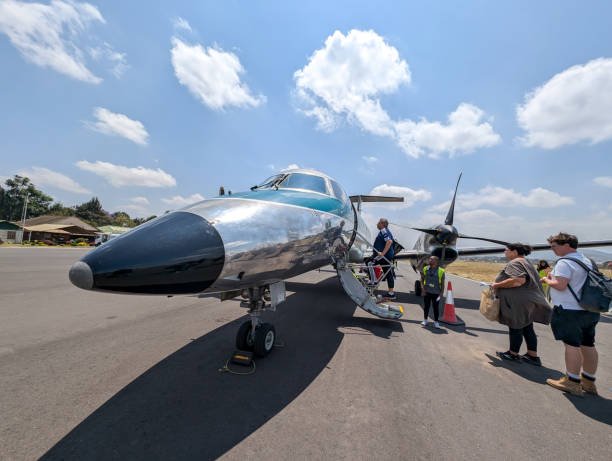
This is the area where most family travelers encounter sticker shock. If your itinerary includes a safari, you will likely be using bush airlines like Coastal Aviation, Auric Air, or Flightlink. These operators fly light aircraft (typically Cessna Caravans) into remote airstrips in the Serengeti, Ruaha, or Selous.
Unlike the larger jets that fly between Dar es Salaam and Kilimanjaro, bush flights operate on a seat-capacity basis. Because the aircraft are small (usually 12–14 seats), every passenger, regardless of age, occupies a seat that could otherwise be sold to an adult. Consequently, many bush airlines do not offer child discounts. You should expect to pay the full adult seat price for children aged 2 and up.
When reviewing your safari proposal, do not be alarmed if you see equal pricing for adults and children on these specific legs of the journey. This is standard industry practice in the Tanzanian bush and reflects the logistical reality of operating in remote areas. For more detail on how these bush flight costs compare to standard domestic routes, see our guide on Tanzania Flight Ticket Prices: Economy vs Safari Bush Flights.
Comparison: Domestic Jets vs. Bush Airlines
To help you plan your budget, the table below highlights the general approach to pricing, though individual airline policies fluctuate based on the booking class and seasonal demand.
| Flight Type | Infant (0-2) | Child (2-11) | Adult (12+) |
|---|---|---|---|
| Domestic Jet (e.g., Air Tanzania, Precision Air) | 10% of fare (lap) | Often 75% of base fare | 100% |
| Bush Airline (e.g., Coastal, Auric) | Usually free or 10% | Usually 100% (Full seat cost) | 100% |
| Private Charter | Flat rate per plane | Flat rate per plane | Flat rate per plane |
Note: This table serves as a general guide. Always request a specific quote for your travel dates, as promotional fares or group bookings may alter these percentages.
Documentation and Safety Requirements
When booking flights for children in Tanzania, the administrative requirements are just as important as the price. Airlines are subject to strict aviation safety regulations that govern how children are seated.
Seat Allocations
On larger domestic aircraft, children occupying their own seat are subject to the same safety protocols as adults. This means they must have their own seat belt. If you are traveling with an infant, you are generally required to use a lap-belt extension provided by the cabin crew. On smaller bush planes, there are no “infant” seat belts; the infant must be securely held by the parent, and the pilot will provide specific instructions for takeoff and landing. Because of these constraints, bush airlines may limit the number of infants allowed on a single flight.
Unaccompanied Minors
If you are considering having an older child travel separately—for example, if they are meeting you later in the trip—be aware that policies for unaccompanied minors are very strict in Tanzania. Most domestic airlines require a waiver and a designated adult to meet the child at the arrival terminal. We strongly advise against booking unaccompanied minor travel for children under 16 without direct, pre-arranged support from the airline’s ground staff. If you need help coordinating family arrivals, our team at Climb 4 Africa can assist in managing these logistics.
Strategic Booking for Families
The most cost-effective way to manage child flight ticket prices in Tanzania is to bundle your internal travel with your safari or Kilimanjaro climb. When you book a tailor-made experience with us, we can often secure more favorable group rates or navigate the specific airline fare rules on your behalf.
For instance, if you are flying from Arusha to Zanzibar after a climb, we can advise on whether it is cheaper to use a domestic carrier or a bush airline based on your family’s size and baggage requirements. Often, families overlook baggage allowances; domestic carriers have strict weight limits, and exceeding them with extra gear for children can lead to significant overweight fees. Understanding these nuances is part of our standard support process.
For those looking at specific seasonal travel, such as the high-demand summer months, planning ahead is essential. You can find more specific advice on timing in our articles regarding Tanzania Flight Prices July 2027: Peak Safari Season and Tanzania Flight Prices August 2027: Kilimanjaro & Safari Travel.
Common Questions About Family Flights in Tanzania
Do I have to pay airport taxes for my child?
Yes. Airport taxes and safety fees are generally mandatory for all passengers, including children occupying a seat. Even if the base fare for a child is discounted, the taxes remain the same as an adult’s. Always check if the quote you receive includes these taxes, as they are sometimes listed as a separate line item.
Are there family-friendly seats on bush flights?
Bush flights do not have assigned seating. It is a ‘first come, first served’ basis, or the pilot will assign seats to balance the weight of the aircraft. If you are traveling with a child, please inform us, and we will do our best to coordinate with the operator to ensure your family is seated together, although this cannot be guaranteed by the airline.
Can I bring a stroller on a bush plane?
Space on bush planes is extremely limited. Standard strollers are often too large to fit in the cargo pod. If you are traveling with an infant, we recommend using a soft baby carrier or a collapsible travel system. If you absolutely must bring a stroller, it must be cleared with the airline in advance, and you should be prepared for it to be stored in a separate hold.
Getting Help with Your Booking
Navigating airline websites for domestic and bush flights in Tanzania can be confusing, especially when trying to apply child discounts that may or may not be available on your selected route. At Climb 4 Africa, we specialize in removing this guesswork.
If you are planning your family’s Tanzanian adventure for 2027, reach out to us with your travel dates, the ages of your children, and your intended itinerary. We can provide a comprehensive quote that accounts for these fare rules, helping you avoid surprises at the airport. You can contact our team directly via WhatsApp at +255 747 477 898 or send your travel details to climb4africa@gmail.com or our backup address at info@climb-4-africa.com. We are here to ensure your logistics are as smooth as the safari experience itself.
Navigating Baggage and Check-in Logistics for Minors
While fare rules dictate the cost of your ticket, the operational realities at the airport—specifically regarding baggage and age verification—are where many families face unexpected friction. Understanding these logistical rules is just as vital as understanding the pricing structure, as they directly impact your ability to board the aircraft without incurring last-minute penalties.
Baggage Allowances and Weight Restrictions
A frequent point of confusion for families involves the discrepancy between international baggage allowances and the strict limits imposed by Tanzanian bush airlines. Even if you have booked a child fare, this does not grant the child a separate or increased baggage allowance. In fact, on light aircraft such as the Cessna Caravan, weight is the single most critical safety factor. Most bush operators strictly enforce a 15-kilogram (approximately 33-pound) total weight limit per passenger, which includes both checked luggage and carry-on items. This limit applies regardless of whether the passenger is an adult or a child.
For families, this creates a significant logistical challenge. If you are arriving from an international flight with a standard 23kg or 30kg allowance, you will likely find yourself over the limit the moment you transfer to a bush flight. Because these aircraft operate on strict weight-and-balance manifests, there is rarely flexibility. We strongly advise that families pack using soft-sided, non-rigid bags. Hard-shell suitcases are notoriously difficult to stow in the specialized cargo pods of bush planes and often count against your space quota more aggressively than duffel bags. If your family exceeds the collective weight limit, the airline may require you to purchase an additional ‘seat’ on the aircraft just to transport your excess luggage, which can effectively double your transport costs for that leg of the journey.
Age Verification and Document Checks
Tanzanian aviation authorities and individual carriers are increasingly rigorous about age verification at check-in. If you have booked a child fare (typically for ages 2–11), you must be prepared to present official documentation—such as a passport or a birth certificate—that clearly proves the child’s age on the date of travel. This is not merely a formality; it is an insurance and safety requirement.
We have seen instances where families arrived at the airstrip having booked a child ticket for a passenger who had turned 12 just days prior. Under the strict fare rules of most Tanzanian carriers, the airline is obligated to charge the difference between the child fare and the full adult fare on the spot, often at the ‘walk-up’ rate rather than the pre-booked rate. In extreme cases, if the aircraft is already at maximum capacity for the flight, the airline may deny boarding if the weight calculation for an ‘adult’ passenger pushes the aircraft over its safe operational limit. Always verify that your booking reflects the age of the child on the day of the flight, not the age they were when you initially planned the trip months in advance.
Connecting Flights and Interlining Issues
One of the most common pitfalls for family travel in Tanzania is the assumption that baggage will be ‘through-checked’ from an international flight to a bush flight. In almost all cases, this is not possible. Bush airlines operate independently of major international carriers. You must collect your luggage at the international terminal (such as Kilimanjaro or Dar es Salaam), clear customs, and then physically transport your bags to the domestic terminal or the bush flight departure lounge. This transition period requires you to manage your children, your carry-on items, and your checked baggage simultaneously. Planning for this ‘gap’ in your itinerary—ensuring you have enough time between your international arrival and your bush flight departure—is essential to avoid the stress of missing your connection due to baggage handling delays.
Navigating Cancellations, Refunds, and Operational Disruptions for Minors
While booking your flights is the first step, understanding how your child’s ticket behaves when plans change is equally vital. In the Tanzanian aviation sector, the rules governing cancellations and refunds for children are rarely as flexible as those offered by major international carriers. Because most child fares are tethered to the specific fare class of the accompanying adult, they inherit the same restrictive conditions. If you have purchased a discounted ‘Saver’ or ‘Promo’ fare for your family, it is highly likely that these tickets are non-refundable and non-transferable, regardless of the age of the passenger.
When a cancellation occurs, the financial impact for a family can be significant. Most domestic airlines in Tanzania operate on a ‘use it or lose it’ basis for promotional child fares. If you must cancel your trip, you will often find that you are only entitled to a refund of the airport taxes, while the base fare is forfeited. It is essential to review the specific fare rules at the time of booking rather than assuming a standard industry-wide cancellation policy applies. We strongly advise families to secure comprehensive travel insurance that specifically covers ‘cancellation for any reason’ or ‘flight disruption’ to mitigate the risk of losing the full value of your children’s tickets.
The ‘Family Split’ Risk During Flight Disruptions
One of the most stressful realities of flying in Tanzania—particularly when using bush airlines—is how the operator handles delays and cancellations caused by weather or mechanical issues. Because bush planes are small (typically 12 to 14 seats), they rarely have the capacity to rebook an entire family on the next available flight if a disruption occurs. In the event of a cancellation, the airline may be forced to split your family across different flights or even different days to accommodate existing bookings.
This scenario is particularly challenging when traveling with minors. If you are separated, you must ensure that your children are equipped with all necessary documentation, including their passports and emergency contact information, and that you have a clear plan for reuniting at the destination. While airline staff will always prioritize safety, they cannot always guarantee that a family will travel together during a recovery operation. If you are traveling with very young children, it is crucial to communicate your need to remain together to the airline representative as soon as a delay is announced. While they cannot always override capacity constraints, they are often more willing to work with you on a solution if you are proactive rather than waiting for them to assign you to the next available seat.
Medical Clearance and Special Assistance
Unlike large commercial jets, which are equipped with medical oxygen, specialized seating, and cabin crew trained to manage various medical needs, bush planes are essentially ‘air taxis’ with limited infrastructure. If your child has a medical condition, requires specific dietary meals, or needs to travel with medical equipment (such as a portable nebulizer or specialized support seat), you must disclose this at the time of booking. Do not assume that the airline will have the capacity to accommodate these needs on the day of departure.
For children with specific medical requirements, the airline may require a ‘fit to fly’ certificate from a medical professional. This is particularly relevant if your child has recently undergone surgery or has a condition that could be exacerbated by the cabin pressure or the duration of the flight. Furthermore, because bush flights are often unpressurized or fly at lower altitudes, the physical environment is different from that of a jet. Always verify with the airline whether they can accommodate your child’s specific medical equipment in the cargo pod or the cabin, as space limitations often mean that non-essential items must be left behind. Failure to declare these needs in advance can lead to boarding being denied at the airstrip, as the pilot is the final authority on what can safely be transported on the aircraft.
Insurance and Liability Considerations for Minors
When flying with children in Tanzania, it is vital to recognize that standard travel insurance policies often fall short of covering the specific risks associated with bush aviation. Many international travel insurance plans explicitly exclude coverage for “light aircraft” or “non-scheduled air transport,” which is the precise classification for the Cessna Caravans and similar small planes used for safari circuits. This creates a significant coverage gap: if your flight is delayed, cancelled, or if you face baggage issues, you may discover that your policy provides no reimbursement because the mode of transport does not meet the insurer’s definition of a commercial carrier.
Furthermore, the liability limits of bush operators in Tanzania are distinct from those of major international airlines. While international carriers operate under strict global conventions (such as the Montreal Convention) that mandate specific compensation for delays, lost luggage, or passenger injury, bush operators function under different, often more restrictive, domestic liability terms. This means that if you encounter a service disruption, you cannot rely on the same legal or financial compensation mechanisms you would expect from a major jet operator. Before finalizing your booking, always request the airline’s “Conditions of Carriage” to understand their liability cap for children, which is often lower than that for adults.
Finally, consider the critical issue of medical evacuation. While not a direct component of your ticket price, it is a primary liability concern for families. Many standard travel insurance policies will only provide coverage for evacuation from major international hubs like Kilimanjaro International Airport (JRO) or Julius Nyerere International Airport (DAR). However, if your child requires urgent care while in a remote safari region, the cost of a private medical flight from a bush airstrip can be astronomical. Ensure your policy specifically covers “MedEvac from remote airstrips” and includes the specific remote locations on your itinerary. Do not assume your existing coverage extends to these specialized, high-risk flight segments.
Related Guides and Packages
Check Availability for Child Flight Ticket Prices In Tanzania: Airline Fare Rules & Planning Guide
Ready to compare dates, prices, and the best option for your group? Send the package name and travel month so the team can reply with a clear quote, availability, and what is included.
Tanzania Flight Ticket Prices: Economy Vs Safari Bush Flights Explained
A practical guide to understanding the cost and logistical differences between commercial economy flights and private-style bush flights in Tanzania.
View package details
Tanzania Flight Prices November : Seasonal Airfares And Booking Guide
A practical guide to understanding Tanzania flight pricing for November 2027, covering seasonal weather impacts, airport selection strategies, and booking timelines.
View package details
Tanzania Flight Prices October : Airlines & Booking Guide
A detailed guide on navigating flight prices and airline bookings for Tanzania travel in October 2027, covering international routes, domestic connections, and planning strategies.
View package details
Tanzania Flight Prices June : Safari Season Airfares
A practical guide to navigating flight costs and logistics for Tanzania in June 2027, focusing on the seasonal shift from shoulder to peak.
View package detailsTanzania Flight Prices May : Ticket & Travel Routes
Planning your Tanzania trip for May 2027? Understand the seasonal flight dynamics, the difference between domestic and international routes, and how to optimize your travel budget during...
View package detailsTanzania Flight Prices March : Airfare & Seasonal Guide
A practical guide to understanding flight pricing for Tanzania in March 2027, covering seasonal trends, booking windows, and logistics for safari and Kilimanjaro itineraries.
View package detailsTanzania Flight Prices January : Airlines & Booking Tips
Practical advice on navigating air travel to Tanzania for January 2027, covering seasonal demand, airline choices, and booking strategies for safaris and climbs.
View package details
Entebbe To Tanzania Flights: Ticket Prices And Route Guide
A comprehensive guide for travelers planning flights from Entebbe to Tanzania, covering ticket price factors, route options for Kilimanjaro and safari tours, and essential booking logistics...
View package details
Best Airlines For Tanzania Safari Flights: Prices & Comparison ()
A guide to navigating Tanzania's domestic airline market for safari travel, covering reliability, baggage constraints, and booking strategies for 2027.
View package detailsNairobi To Zanzibar Flights: Ticket Prices & Booking Guide
A comprehensive guide to understanding flight costs, airline choices, and logistics for the popular Nairobi to Zanzibar route.
View package detailsKilimanjaro International Airport Flight Prices & Airlines: A Planning Guide
A deep look at planning your travel to JRO, understanding airline options, price variables, and how to coordinate your arrival for a successful Kilimanjaro climb.
View package detailsFlights To Mount Kilimanjaro: Ticket Prices & Airport Guide
A comprehensive guide to flying into Kilimanjaro International Airport (JRO) in 2027. Learn how to secure the best flights, what to expect at the airport, and how to align your arrival with...
View package detailsNo related package matches those filters. Clear one or more filters to see the other topic-matched options.



