
Arusha to Serengeti return flights are round-trip light-aircraft services linking Arusha Airport with one of Serengeti National Park’s airstrips — Seronera, Kogatende, Lobo, Ndutu, Kusini or Grumeti — and then bringing you back on a later date. The practical answer most travellers need: budget roughly USD 500–900 per person for a scheduled shared return, more for private charters and peak-season dates such as the northern migration window in July–October 2027. That number is not fixed. Your return airfare moves with airstrip choice, season, baggage allowance, how early you book, and whether you fly into one airstrip and out of another. Plan for 15 kg in a soft bag, tie the flights to your safari nights rather than a fixed clock, and lock seats early.


How a Return Ticket Changes the Shape of Your Serengeti Safari
Most people picture the flight first and the safari second. In practice it is the other way round. The moment you commit to Arusha to Serengeti return flights, you have fixed two hard dates in a journey that is otherwise soft — the day you land in the park and the day you leave it. Everything between those dates bends around them.
That is not a drawback. It is the reason flying works. A return ticket turns a long, punishing road transfer into roughly an hour in the air each way, and it buys back days. The drive from Arusha to Seronera eats the better part of a full day and leaves you tired on arrival. Fly, and you can be watching elephants by late morning and still be back in Arusha in time for a Kilimanjaro briefing or an evening flight onward.
The trade-off is rigidity. A one-way flight lets you drive out the far side of the park and continue somewhere new. A return flight closes the loop, so the park has to hold enough interest to justify staying inside it. For most first-time visitors on a 3 to 5 night Serengeti block, it absolutely does. For anyone wanting to combine the Serengeti with Ngorongoro and Lake Manyara on the ground, a single one-way flight in and a scenic drive out often makes more sense — a question we unpack in is it better to fly into Serengeti or drive from Arusha.
What “Return” Really Means on Serengeti Flight Circuits
Here is where booking gets interesting, and where a lot of travellers arrive with the wrong mental model. A “return” ticket in the Serengeti is rarely a simple there-and-back to the same strip. The scheduled operators run a loop system, and a return fare is usually built from two one-way sectors stitched together on the same ticket.
So a genuine return can look like this: fly Arusha to Seronera on day one, spend four nights in the central Serengeti, then depart from Kogatende in the north after the migration has moved. That is still sold as one return journey — an open-jaw return — and it is often the single smartest airfare decision on a Serengeti itinerary. You are not paying twice for the privilege of entering and leaving through different doors.
The strips that matter most:
- Seronera — the workhorse of the central Serengeti. Year-round game, the densest accommodation cluster, the most daily departures to and from Arusha.
- Kogatende — northern Serengeti, the Mara River crossing zone. Busiest July to October, and the strip most people mean when they talk about the migration.
- Lobo — quieter northern-central strip, useful when Kogatende seats are tight or when you want fewer vehicles around you.
- Ndutu — southern short-grass plains, seasonal, running roughly December to March for the calving herds.
- Kusini and Grumeti — smaller southern, central and western strips tied to specific camps and conservancies, with thinner schedules.
If your camp sits near one of the thin-schedule strips, the airline may still sell you a return, but the timings will be less generous. That is a real cost, even if the fare looks similar.
Airlines and Airstrips That Make the Arusha–Serengeti Loop Work
This is a light-aircraft market, not a jet market. The operators running scheduled Arusha–Serengeti services use small fixed-wing aircraft — typically 12 to 14 seaters on the main runs, with smaller Caravans and Cessnas on thinner sectors. Because everybody is flying the same basic metal and the same strips, the differences between carriers come down to schedule density, baggage policy, luggage-handling reliability and how well they absorb a weather delay.
What matters to you as a buyer is not the brand painted on the tail. It is three things: how many departures a week touch your chosen strip, whether the return leg is a morning or afternoon service, and whether the airline will hold your seat when your dates shift by a day because a safari camp had a hiccup. The third point is where a local operator earns their keep, because a direct online booking gives you a ticket number and very little else.
For a closer look at how fares vary by operator and sector, our breakdown of Arusha to Serengeti direct flights, ticket costs and schedule goes deeper into the timetable side.
Which airstrip suits which safari
Central Serengeti via Seronera is the safe all-rounder and the easiest to pair with Ngorongoro on the ground. Northern Serengeti via Kogatende is the choice for river crossings and for anyone travelling in the July–October 2027 window who wants to be close to the action rather than driving three hours to reach it. Southern plains via Ndutu only make sense in the green season. Grumeti and Kusini suit travellers whose camp choice is already fixed and who accept a leaner flight schedule in exchange. We cover the northern sector in more detail under Arusha to Northern Serengeti flight prices and booking and the river-crossing strip specifically in Arusha to Kogatende airstrip flights.
What Actually Drives Your Return Airfare
People ask why one quote comes back at a comfortable level and another looks almost double for what sounds like the same trip. The gap is almost never the airline being greedy. It is these variables stacking up.
| Factor | How it moves the return fare |
|---|---|
| Season | High season and the migration window push fares and seat pressure up sharply; green-season travel softens both. |
| Airstrip | Seronera is the cheapest and most competitive. Kogatende, Grumeti and Kusini carry a premium because fewer aircraft serve them. |
| Shared vs private | Scheduled shared seats are the affordable route. A private charter gives you your own timings and your own strip — and a much higher invoice. |
| How far ahead you book | Early booking mostly buys availability, not discounts. Late booking sometimes means paying peak fare for a middle seat. |
| Open-jaw routing | Entering one strip and leaving another usually costs little more than a same-strip return and saves enormous ground time. |
| Baggage over the limit | Extra kilos are charged per kilo on the day, and on a full aircraft they may simply be refused. |
| Date changes | Moving a light-aircraft seat late is expensive or impossible. This is the hidden cost in flexible itineraries. |
Indicative Airfare Bands for 2026 and 2027
Exact fares are quoted per booking because they depend on the factors above, but the market does sit in recognisable bands. Treat these as planning figures, not published rates — the final number comes back as a written quote once your dates and airstrip are fixed.
| Option | Indicative fare (per person) | Best suited to |
|---|---|---|
| Scheduled shared return, low/green season | Roughly USD 480–650 | Flexible travellers, Dec–Mar plains trips, budget-conscious couples |
| Scheduled shared return, high season | Roughly USD 600–900 | Jun–Oct departures, river-crossing trips, standard safari packages |
| Return with open-jaw routing | Close to the same band | Anyone entering central and leaving northern Serengeti |
| Private charter return | Quoted per aircraft, not per seat | Groups of 4–6, photographers, families wanting fixed timings |
One clarifying point: child fares on these sectors are often not discounted the way they are on international routes, because the seat costs the airline the same whether a nine-year-old or an adult occupies it. Families should budget close to full fare per head and focus savings on camps instead. Our older piece on how much a flight from Arusha to Serengeti costs and the 2027-focused Arusha to Serengeti flight price and safari airstrips guide both look at how numbers shift between seasons.
Booking Windows, Seat Blocks and Why Early Beats Cheap
The single most common booking mistake is treating these flights like international airfare and assuming a fare will drop if you wait. It will not. On light aircraft there is no dynamic pricing engine playing games with you — there are 12 or 14 physical seats, and when the high-season block sells out, your only alternatives are a different airstrip, a different day, or a private charter at several times the cost.
For 2026 travel, the practical advice is to hold your flights the moment your safari camps are confirmed, ideally four to six months ahead for June to October departures. For 2027, especially July, August and the first half of September, six to nine months ahead is not excessive — that window is when the northern Serengeti fills fastest and when Kogatende seats vanish first.
What to have ready before you request a quote
- Exact travel dates, or a two-day flexibility window
- Which Serengeti sector you are sleeping in, and for how many nights
- Number of travellers and total soft-bag weight per person
- Whether you want the same airstrip in and out, or an open-jaw return
- Your arrival and departure flights into Arusha or Kilimanjaro, so connections can be checked
- Any onward leg — Zanzibar, Dar es Salaam or home — that the return date has to serve
Baggage, Check-In and the Details Travellers Get Wrong
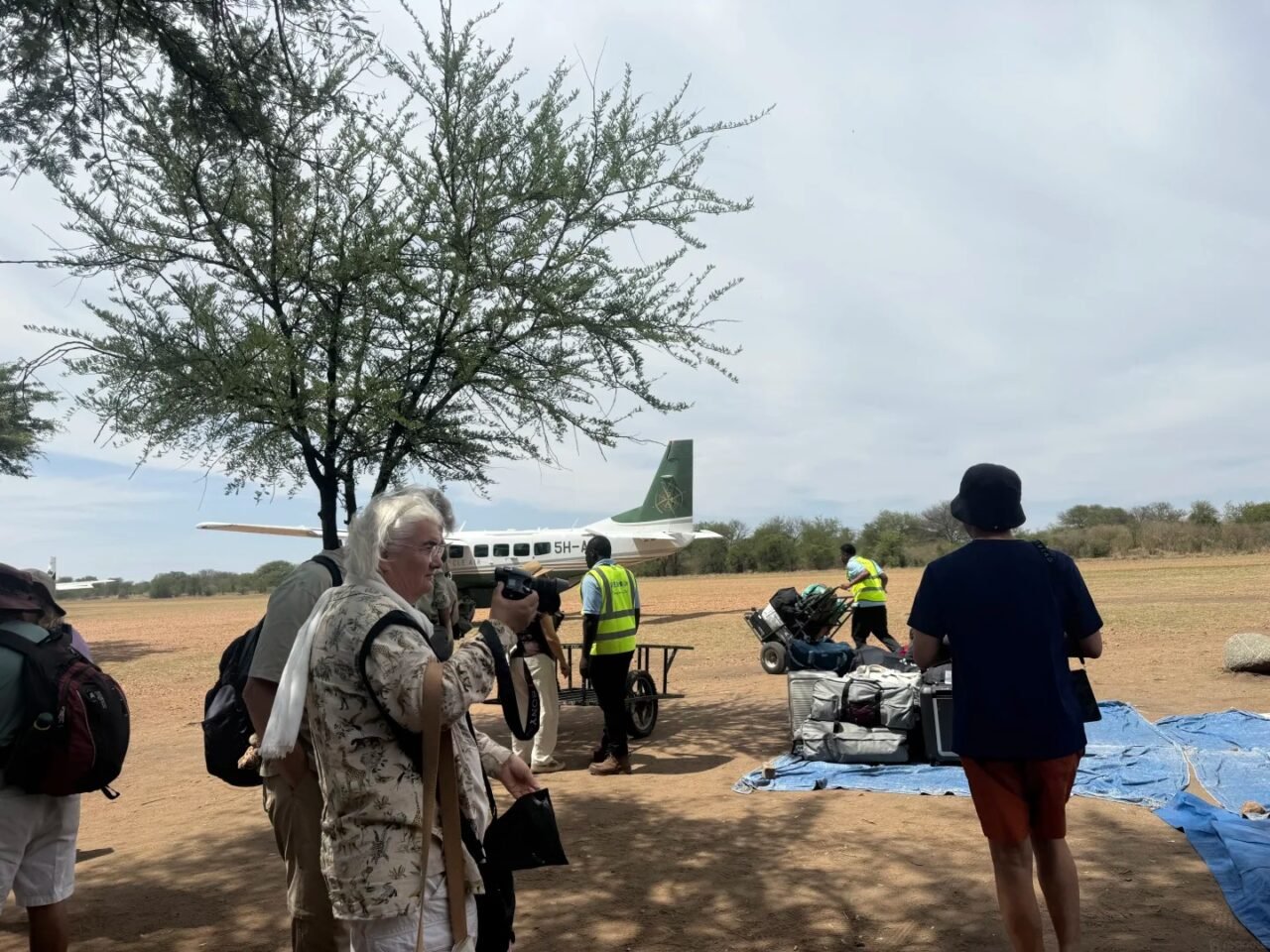
Light aircraft rules are stricter than anything you have met on a scheduled airline, and the rules are enforced at the strip, not negotiated.
The standard allowance on Tanzania safari sectors is 15 kg per person including hand luggage, packed in a soft-sided bag with no rigid frame and no wheels that stick out. That last detail trips people up constantly. A hard-shell suitcase that fits the weight but not the hold shape will be left behind or repacked on the apron. If you are continuing to Zanzibar after the safari, check the onward sector separately — allowances there can differ, and the Arusha to Zanzibar one-way and return flight prices guide covers how that leg is priced and packed.
Other practical points worth knowing before you fly:
- Departure times are not fixed. Operators consolidate flights, so a 10:30 departure may become 11:15. Build slack into any same-day international connection.
- Check-in at a bush strip is a handshake and a manifest, not a terminal. Be there 30 minutes early.
- Park fees are separate from the airfare. Flying into the Serengeti does not exempt you from entry fees, and those are usually settled by your operator or camp.
- Weather delays happen, most often in the long rains around April and May. Travel insurance that covers trip interruption is worth more on this route than on a normal holiday.
Building a Safari Itinerary That Flows Around the Flights
The best Serengeti itineraries are built backwards from the return flight. Start with the day you must be back in Arusha, subtract the nights you want in the park, and set your outbound date from there. Then choose the airstrip pair that shortens your driving on the ground.
A pattern that works repeatedly for 2026 and 2027 travellers: fly Arusha to Seronera on day one, spend two nights in the central Serengeti for big-cat country and the Seronera River circuit, then drive north over a day, spend two nights near Kogatende for the river, and fly Kogatende back to Arusha. That is a return ticket doing the work of two one-ways, and it removes the longest road day from the trip entirely.
If your budget is tighter, the same shape works in reverse on the ground: fly in to Seronera and drive back out via Ngorongoro, which folds a crater night into the journey home and often costs less overall than adding a second flight. Our round-up of Tanzania safari group departures and shared tours shows how these flight-linked itineraries sit inside fixed departure dates, which is useful if you would rather join a scheduled group than build privately.
Where the return flight genuinely earns its price is on trips of three nights or fewer in the park. On a short block, a road transfer would consume most of your first and last day. Flying gives you those days back, which is why the fare so often pays for itself in usable safari time rather than in cash.
When a Return Flight Is the Wrong Answer
Honest advice saves people money. A return flight is not always the right call.
Skip the return if your safari continues south and west — for example Serengeti into Ngorongoro, Lake Manyara and Tarangire — because you would be flying back to Arusha only to drive out again in the same direction. Skip it if your group is large enough that a private charter return becomes cheaper per seat than scheduled fares on a thin-schedule strip. Skip it if you are travelling in the deep green season and want to keep dates loose, since a fixed return punishes flexibility. And skip it if your camp is already positioned for a scenic drive out that you actually want to experience — the Ngorongoro Highlands road is not a chore.
Where a return flight wins is almost always the same profile: a short, focused park stay, a fixed arrival and departure in Arusha, and a traveller who values time over ground scenery.
Booking Arusha to Serengeti Return Flights with Climb 4 Africa
For 2027 planning, the value of booking these seats through a Tanzania-based operator is not a discount — it is that somebody local is holding the pieces together when a camp date moves, a charter consolidates, or a connection looks tight. We build the airfare into the safari rather than selling it as a separate product, which means the return date is chosen to fit the game viewing, not the other way round.
Send us your dates, the Serengeti sector you are staying in, your party size and total bag weight, and whether you want the same airstrip in and out or an open-jaw return. If you are still deciding between flying and driving, say so and we will cost both honestly, side by side. You will get a written quote with the airline, aircraft type, departure windows and baggage allowance made clear before anything is paid.
Message us on WhatsApp at +255 747 477 898 or email climb4africa@gmail.com to start the quote. If your broader plan includes a Kilimanjaro climb or a Zanzibar finish, tell us that at the same time — it usually changes which return
Check Availability for Arusha To Serengeti Return Flights: Airfare & Booking 2027
Ready to compare dates, prices, and the best option for your group? Send the package name and travel month so the team can reply with a clear quote, availability, and what is included.
Cheap Flights From Arusha To Serengeti: Prices & Booking 2027
Cheap Flights From Arusha to Serengeti: Prices & Booking is explained with current 2027 planning, price, itinerary and booking information.
View package details
Fly From Arusha To Serengeti For A 3-Day Safari: Flights & Package Prices 2027
Discover the most efficient ways to fly from Arusha to the Serengeti for a concentrated 3-day safari. This guide breaks down airstrip choices, flight costs, and package structures for 2027.
View package detailsArusha To Northern Serengeti Flight Prices & Booking Guide () 2027
A comprehensive guide detailing the logistics, costs, and best practices for flying from Arusha to the Northern Serengeti for your 2027 safari.
View package details
Arusha To Serengeti Direct Flights: Costs, Schedule, And Travel Planning Guide
A deep look at planning the direct flight from Arusha to Serengeti, covering costs, schedules, airline options, and essential safari logistics for 2027.
View package detailsSerengeti To Zanzibar Vs Arusha To Which Is Better After Safari? 2027
Choosing the right transfer to Zanzibar after a safari—Serengeti to Zanzibar or Arusha to Zanzibar—depends entirely on your safari route, time constraints, and budget. This guide breaks...
View package detailsArusha To Serengeti Flying Safari Vs Road Full Cost Comparison 2027
Arusha to Serengeti Flying Safari vs Road Safari: Full Cost Comparison is explained with current 2027 planning, price, itinerary and booking information.
View package details
How Much Is A Flight From Arusha To Serengeti? 2027
How Much Is a Flight From Arusha to Serengeti? is explained with current 2027 planning, price, itinerary and booking information.
View package detailsArusha To Serengeti Flight Price : Tickets & Safari Airstrips 2027
Arusha to Serengeti Flight Price 2027: Tickets & Safari Airstrips is explained with current 2027 planning, price, itinerary and booking information.
View package detailsFly Into Serengeti Or Drive From Arusha? The Ultimate Tanzania Safari
Choosing between flying directly into the Serengeti or driving from Arusha is a pivotal decision for any Tanzania safari. This guide breaks down the advantages and disadvantages of each...
View package details
Singita Serengeti Airstrip Flights: Charter Prices And Expert Booking Guide
Planning your journey to Singita Serengeti requires careful flight planning. This guide details charter options, cost considerations, and the booking process for a smooth 2027 luxury safari.
View package details
Fly-In Safari To Ngorongoro And Serengeti: Flights & Transfer Costs 2026-2027
Discover the logistics and cost breakdown for a fly-in safari to Ngorongoro and the Serengeti, including airstrip transfers, baggage limits, and vehicle positioning.
View package detailsSerengeti South Airstrip Flights: Prices & Seasonal Access 2027
Serengeti South Airstrip Flights: Prices & Seasonal Access is explained with current 2027 planning, price, itinerary and booking information.
View package detailsNo related package matches those filters. Clear one or more filters to see the other topic-matched options.



